
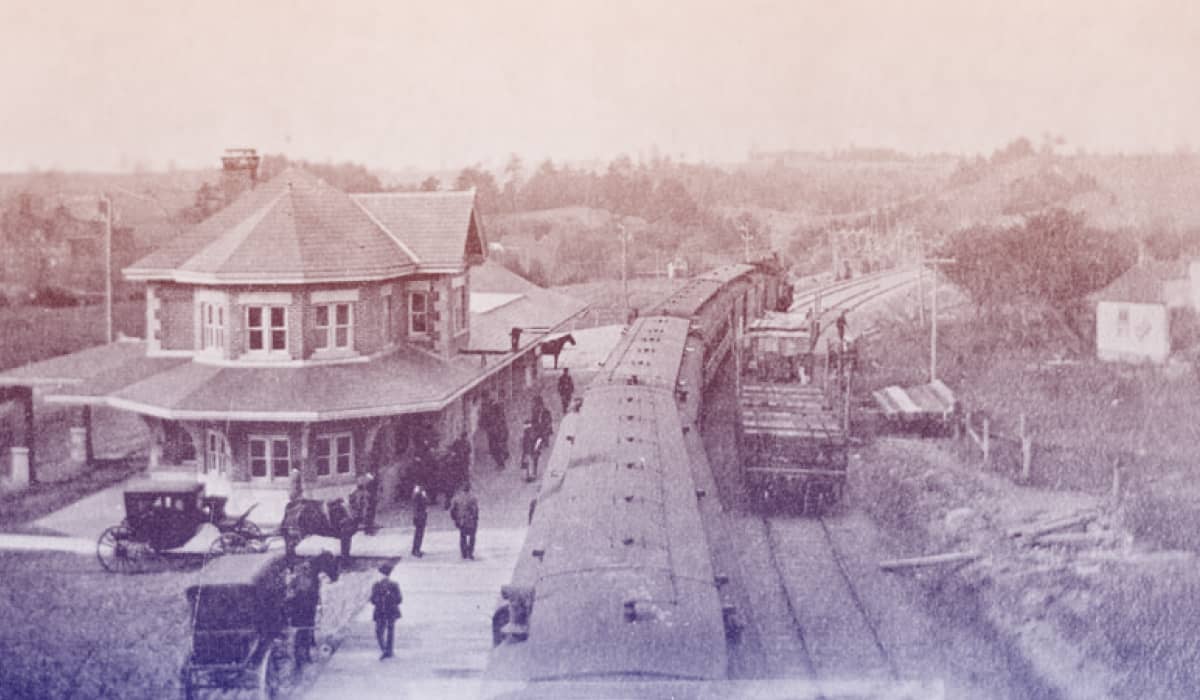
by Susan Layard, first published in the February 2025 issue of ACO Matters
The old red brick building located on the corner of Ontario Street and Hope Street North was the original 1911 Port Hope stop of the Canadian Northern Railway (CNoR), a transcontinental railway company founded by William Mackenzie and Donald Mann of Toronto at the beginning of the 20th century.
The property is now owned by the Provincial Government, and the building has been housing a Ministry of Transportation office for many years. The property is currently for sale, however, and the parcel of land containing the station could be eligible for heritage designation once sold.
Bruce Bowden maintains that “the creation of the Canadian Northern Railway by Toronto entrepreneurs, Mackenzie and Mann was Canada’s second great nation-building engineering project.” Immigrants were pouring into the Prairies during this time, but at first they were “at the mercy of the monopolistic Canadian Pacific Railway (CPR),” needing to buy their land from the railway’s 25 million acres that it had been granted by Ottawa in 1882, then needing to ship their grain on the only railway line at their disposal. It wasn’t long before the new farmers began to demand that the CPR’s monopoly be broken. Mackenzie and Mann were the first to take up the challenge, and so the CNoR was born.
The new transcontinental, originating in Winnipeg, was very popular and successful in the West, with new stations quickly appearing across the Prairies. The East, however, with many more established railways, was much less welcoming, eventually spelling the demise of this fledgling transcontinental railway.
Even in 1900, Port Hope already had two railways and two stations: that of the Grand Trunk and that of the Port Hope–Midland Railway. The third station came in 1911, when Port Hope became a stop along the CNoR main line that connected Toronto to Ottawa. The CNoR created a line from Belleville that passed through Cobourg, Port Hope, Osaka, Orono, and Bowmanville, and then gradually headed into Toronto near Todmorden Mills on the Don River.
The trestle bridge over the Ganaraska River was a major engineering challenge. Bruce Bowden tells us that “CNoR’s very tall steel trestle bridge crossing the Ganaraska River was imposing, scary to view and far less stable than the concrete edifice that the CPR built in 1913.” Trains would have to travel slowly, and their weight was strictly controlled.
In its early days, the CNoR passenger service along this line was very popular, and the train pulled three well-filled coaches just after the line opened in 1911. Soon, more and more cars were added so that eventually the train’s engine was pulling 15 coaches by the time the train reached Toronto. Things changed, however, once the Grand Trunk Railway Company had also embarked upon their transcontinental project, and by the end of the First World War both the CNoR and the Grand Trunk Railway Company were bankrupt.
The Belleville, Cobourg, and Port Hope CNoR stations were all built to one of the standard style types devised by railway architect Ralph Benjamin Pratt, whose railway designs were scattered all across Canada. He worked for the CPR and then the CNoR, and he became particularly well known for his creative use of standard design plans for railway stations. According to the Winnipeg Architecture Foundation, “Pratt had a profound effect on the architecture of standard plan stations.” His rooflines, in particular, “became an instantly recognizable corporate trademark.” Both the CPR and the CNoR continued to use the standard plans he created even after he formed his own firm in 1906.
The three standard plan CNoR stations in this area were representative examples of the Chateauesque style of railway design prevalent at that time. They were all two-storey buildings with gables in the roofline, stone quoins and lintels, and a complex hip roof design which simulated a Chateauesque turret. They were also all related to the earlier CNoR stations built in St. Boniface, Manitoba and Fort Francis, Ontario, except that these older stations displayed an actual turret instead of the complex hip roof.
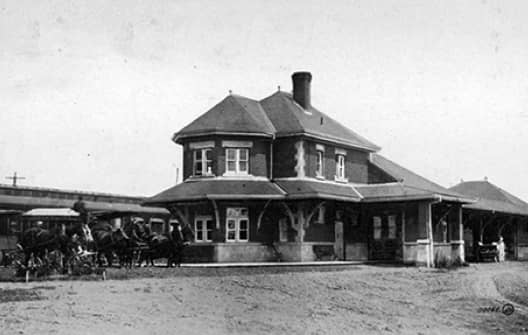
Yet, of these similarly designed CNoR stations, only the red brick Port Hope station at 138 Hope Street survives to remind us of this Canadian railway story that is mostly forgotten today.
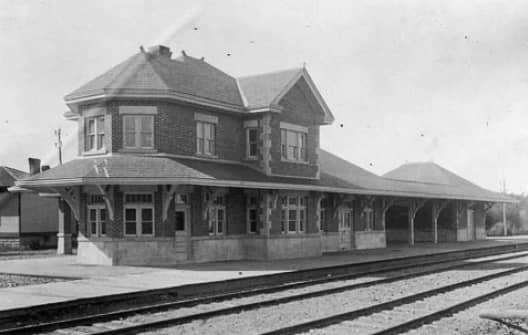
The old CNoR station in Port Hope is certainly deserving of heritage recognition. After the station was abandoned, the building remained in its current location and was converted to other uses, eventually becoming a Ministry of Transportation office. Additions were built, and the original windows were replaced. Nevertheless, the east end of the station still retains its Chateauesque hip roof, brick cladding, and its stone quoins and lintels, all of which contribute to its design value. Moreover, the windows could be replaced more sympathetically.
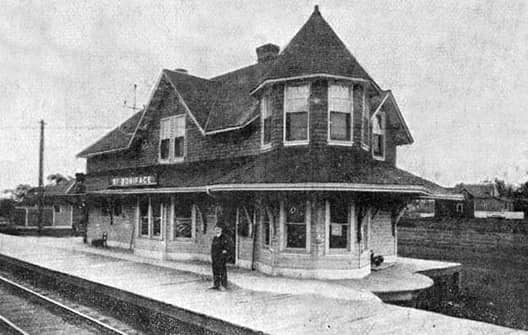
In addition, the station reflects the work and ideas of architect Ralph Benjamin Pratt and could be considered a landmark, as the standard station’s Chateauesque style with the unique hip roof makes it an easily recognizable structure in the Town.
The station also has historical associations with the railway building boom during the Laurier Era which, according to Bruce Bowden, brought together Canada’s vast territories and “resulted in the building of three continental railways with two northern routes, one heading down to Vancouver via the Thompson River Gorge and one directly across BC to Prince Rupert, as well as the creation of the Canadian National Railway, a Crown Corporation, in 1921.” The station, along with the remains of the trestle bridge’s concrete abutments, also speaks to the complex engineering story of railway building at that time.
The former CNoR station at 138 Hope Street North is an important heritage resource in Port Hope. Let’s recognize its heritage significance after the provincially owned site is sold and imagine a new future for this unique property.
Feature image credit: Port Hope and District Historical Society